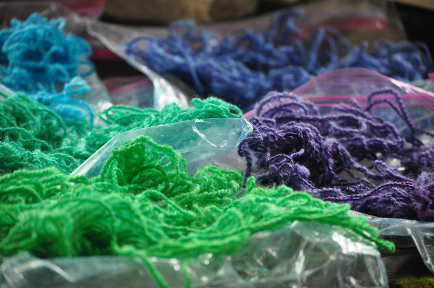
It started with this dye vat, using up the leftover fibre reactive dye. I'd found this bag of Acala cotton roving that I'd put on the back of the cellulose fibre shelf. I know I bought it for a level 3 or 4 homework session, because it was specifically labelled Acala cotton. It is shorter than Pima or Egyptian cotton, so a tad harder to spin. I have a bag of Acala cotton lint, which is easy to card into punis and quite easy to spin.

I was pretty happy with the dye results, although it was definitely a tad uneven. The roving came out fairly unscathed and hardly compacted at all. That made me very happy was well. Once it was dry, I started to spin it. Then I remembered why it had been shoved to the back of the shelf. The roving is full of neps, little balls and clumps of fibre that just didn't want to spin and were the devil to pick out. Then I remembered that I didn't even bother with this roving for my homework, because it was awful to work with.
Since I'd dyed just over 50 g of fibre, I wasn't going to waste it. I haphazardly divided it into 2 sort of equal pieces. I carded it up into punis. Lots and lots of punis. I carded 6 or so at a time and then spun it up, switching to a different bobbin for the second half of the fibre.
It was quite easy to spin but really difficult to maintain any kind of consistency, with all those neps. I tried really hard to pick them out, or attenuate them some how, or just smooth them out and pack them in, to create at least an illusion of consistency. However, in the end, it was obvious that my efforts were being wasted, so I just spun it up quickly, to get it over with.
All things considered, the yarn turned out quite nicely. It is definitely not my best yarn every made, but it is much more consistent in grist that looks than I'd anticipated. So, I'm happy. It is soft, pretty and useable. The colour and grist will go nicely with the blues I spun and dyed this summer at Olds during the level 6 class.


 I was pretty happy with the dye results, although it was definitely a tad uneven. The roving came out fairly unscathed and hardly compacted at all. That made me very happy was well. Once it was dry, I started to spin it. Then I remembered why it had been shoved to the back of the shelf. The roving is full of neps, little balls and clumps of fibre that just didn't want to spin and were the devil to pick out. Then I remembered that I didn't even bother with this roving for my homework, because it was awful to work with.