Pages

January 02, 2022

New Loom and Wintery Weather


The rigid heddle loom came unfinished and unassembled.  I stained it with what used to be a Minwax stain, but is now labelled Varathane.  It's the same colour range and label though, just with a new brand.  Then I coated it with 2 coats of Behr tung oil.   I checked around to see what a new tin cost, as I'm almost out of this one.   It turns out it was discontinued over 10 years ago.   I used it anyway, and still have some left in the tin.  There are a couple of other brands of tung oil out there.   I don't know if they have the same warnings as this one - don't throw out any rags or brushes used with this stuff, unless you let them completely dry first.   I just store them outside until dry or it's garbage day.  Less risk of them combusting inside.    

Putting it together was easy.   Everything is pre-drilled and the instructions are straight forward.  Of course it was easier for me since I walked into the room where I'd been working on it and found hubby assembling it for me.   

I used the direct warping method, which is really easy and amazingly fast.   I used the yarn I'd recently dyed.  It was a knitting yarn, wool, Lion Brand Fisherman's wool.   I used the 7.5 dent reed.  The dyes were a dark  blue and a warm red.  It blended somewhat to give lovely denim blue shades and some rusty oranges.   I love the colours.  The warp is 10 inches wide and was 3m long.  I had done the calculations as I would for one of my multi-shaft looms and came up with 3.2 m in length.   After doing some more research and checking out other people's projects, I reduced the length.   I may have been able to shorten it more as it seems that much of the loom waste can be used for fringes if you're using them.

I'd watched a video with a woman introducing the rigid heddle loom, dressing it with the direct warping method and then starting to weave.    She used a stick shuttle which was wound around the middle.  It was so fat that it barely fed through the shed, which on a rigid heddle isn't huge.   While I'm sure there are some reason's why you'd wind a stick shuttle that way, using a figure 8 winding technique on the sides of the shuttle, keeps it flat and holds so much more yarn.   I have found it to be much more efficient to do it this way.

Another video said to remember to put your working yarn in a bowl to keep it from rolling around on the floor.  They neglected to mention that your cat will find it right away since it's contained, grab it in their mouth and run!  At least it wasn't Keven who would have chewed it up.   Phil just likes to get it slobbery.
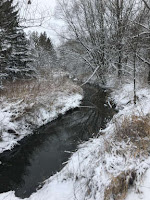
We went on a short hike today.   It was snowing when we left.  Not a lot, but enough.   It was coldish too -6C, but it was the wind blowing in our faces which made us turn around sooner that we wanted.  The stream that runs through this area is still open.   Weirdly, because I've never seen one this late in the season, there was a Blue Heron still there.  

Usually, they migrate a bit farther south.    While we're not all that far from what is considered their year round habitat, it was still surprising to see one this late in the season.    Of course, our weather has been weird, with winter weather interspersed with milder weather.   Maybe that is why he was still here.

Some fungi that was on a log that I came across on yesterday's walk.    So interesting!


December 26, 2021

Pretty colours and chooks

 It has been a very odd few weeks.   Weatherwise, we've had nothing but variable weather.  From the ridiculously mild, to cold and blustery, with rain, snow and winds inbetween.   What we've had little of is sunshine.   Day after day of grey weather.   Just so difficult to get motivated when it's getting dark at 4:30 pm and isn't light until after 7 am.   Then the wind storms, wifi outages and power failures just topped it off.   On the plus side, I did finally force myself to figure out how to use my phone to make a hot spot for my computer.  It wasn't difficult.  I just hadn't really been in a situation where I needed to do it.

In between, I did some fibre blending.  I made up a bunch of packets of rolags from some bits and pieces of fibre that needed to be used up.   These are merino, corriedale, silk, with a bit of angelina or sparkle, which is a local shops nylon, sparkly stuff, similar to firestar. I didn't use a lot of sparkly stuff, just a tad to make it interesting.

Then I blended up some rolags for a new hooked rug.  I didn't want to go out and buy wool yardage for this rug.  It's not an original design and is a guild challenge project.   The photo to the right shows the start of the rug yarn project.   I had to do a bit of concentrating for the first few yards to make sure that I had the grist suitable.   I need a bulky yarn for this project.  It's better if it's a bit uneven in grist (sigh, not my favourite) and has a nice mix of colours.   It spun up quickly because I used a long draw and forced myself to not pay a lot of attention while spinning   It worked though, I got the results I was looking for.

first skeins of rug hooking yarn

I swapped a couple of bags of the first rolags, for a similar amount of roving from a friend.   One bag was a super dark blue shetland/blue faced leicester crossbred fibre and the other was undyed shetland/bfl, and alpaca.    I wasn't too thrilled with the shetland/bfl cross.   From what I could tell, it didn't result in a better fibre.   BFL is long, and quite soft.   This was more shetland-like, in that had a medium crimp, wasn't quite as long, nor as soft.   However, I blended the two fibres together, hand-carded it into rolags and spun it up into a 2 ply worsted.   It's nice enough, mainly I think because it's 25% alpaca.    It's about to become mittens.  No photo right now because it's too dark for a decent photo right now.

Because of the rather scary rise in Covid numbers, my whole family opted to have a stay at home Christmas again.    In the end, I was okay with that, although I missed my kids, I'd just gotten my booster shot, and spent half of Christmas day sleeping!    I did manage to sand all these pieces of a rigid heddle loom though.

 Today, hubby set up a work station in the mud room and I taped up the rigid heddles and stained it all.   Tomorrow, I can put the first coat of finish on it.   Luckily, I still have enough tung oil on hand to put two coats on, which will hopefully be enough.  I can't get more, because I just found out that it was discontinued.  It's the finish I used for my spinning wheels.  I haven't needed to buy any in a while, which is a good thing since it was discontinued in 2010!  

Loom details - 32 in Ashford rigid heddle loom.  It's light weight - 10 lbs,  Available rigid heddle reeds from 5 dpi, 7.5 dpi, 10 dpi, 12.5 dpi, 15 dpi.   It can use 2 reeds at a time, too.  The 7.5 comes with it.  I added the 10 because it would fit in the box and no extra shipping.   At some point I'd like to add another 10, a 12.5 and 15.

I realized that lots of people use rigid heddle looms as a starting point to jump into weaving.  However, I figured that as more than a couple of people have asked me about them, I should learn how to use them.  Also, on days when arthritis means it hurts to weave on the floor loom, table looms work just fine.  They are fast to dress and weave off too, so good for demos!   32in gives a lot of leeway for project possiblities.

There were still some not snowy parts on the lawn, so I let the chooks out that day.   They are pretty wimpy and don't like to wander out of the barn when it snows.   The wild birds had picked through the food in the feeders and scattered a lot on the ground, so the girls headed out to clean it up.   I had leftovers for them too that day.   Later in the afternoon, I heard some insistent knocking at the back door.   This is what I saw!   They either wanted in or wanted me to go out, prolly with treats for them.  There were a couple of the chooks, pecking away at the door.  The rest were just in cahoots!


November 19, 2021

Interesting Hiking


We've been hiking a trail which is about a 25 minute drive from home.  It's not horribly long, but it has lots of things which make it interesting.   It's a circle trail, it has educational spots to explain the local wildlife, pollinator plants, the local lime industry etc.   It has a dog park, several look out points, picnic spots and sie trails so you can wander around on a new trail every time you go.  It runs alongside the river part way, which has been most interesting.   

Lately, we've been seeing a lot of chewed and knocked down trees.  These aren't saplings but trees which are at least 30 cm in diameter and bigger.

As there are no wildlife signs for beavers posted, I wondered if muskrats could do this sort of damage.   There is was a lovely little grove poplar or aspen trees just when you enter the trail.   All the big trees were either chewed down, or in the process of being chewed.

We were there on the weekend and we saw this!  It seems to be a beaver dam under construction.   Since it's in the Thames river, I can't imagine the beaver having the ability to dam the whole river up, but he could have a nice sheltered home for the winter.

I wonder if the people who take care of the trail, will let the beaver stay?  It's made for a lot of curiosity, and interesting conversation over the past few weeks.


We've been having picnics at this spot, overlooking a man-made lake for  water/run off control.  It's spectacularly beautiful and makes you feel you are in some sort of wilderness area.   I spent a fair time watching, what I thought was a muskrat, playing in the water.   I wonder if it was the above beaver instead?   I didn't have a camera with a strong enough lens, to capture it from where I was and my phone would only show little ripples.    I didn't think I needed a 300mm lens or bigger, but I've found a number of situations where it would have been nice to have.


Here is the lake and lookout from a different vantage point, the last time we visited it.  The snow has all melted now, fallen a second time and melted once again.  Except on our deck, which gets no sunshine during the winter months.  

November 07, 2021

Yarn Chicken for the Win!

 Sometimes you lose, and sometimes you win!  Yes!  The grey and self-patterning socks I just finished, I lost and and ran out of the grey, a few rows before I switched colours.   This time, I won, with about 60 cm, or 2 ft. to spare.   Happy me!

  I dyed this yarn several years ago and it sat in the bin.  The yarn base was a tad thicker than I prefer, and thus a bit less yardage.   I used a waffle weave pattern for a change from my usual 3/1 ribbing for every day socks.  I wasn't sure if I liked the colour when skeined, but once knitted, it's quite nice.  A very pumpkin sort of colour, with a bit of orange, a bit of copper and a bit of green.


November 03, 2021

Scarves off the loom

 We don't have a local yarn or fabric store here.  There is however, a large mill ends warehouse, where they have a large stock of regular yarns, quilting fabrics, sewing fabrics, as well as the over stock and over run items.   It's the one place where you can buy last year's hockey logo t-shirt for $5 and full price yarn.   Their sales though, are often really good.   I got 10 yards of brocade there last year for $6.   I was after some tapestry for a pseudo carpet bag project, which I didn't find, but got the brocade instead.  They put fabrics and yarns on sale regularly, with bright yellow tags.   Once in a while they then put those on for half price.   I found a bunch of gradient shawl skeins at one of those sales.  These are knitting yarns and can be a tad delicate to weave with.  I tried one, which was peach to deep burgundy or dark red.  The contrast was too much and the scarf which got the lighter weft, just looked wrong. 

  Next time they had the sale, they still had some of those gradient skeins.   I found 3 different colourways with much less contrast.   This is my favourite so far, in browns, greys and yellows.   Not colours I might normally wear, but very pretty when woven up.   I just got these off the loom this morning!  These ones are cotton and acrylic.    They are a tad longer, running between 74 and 79 inches in length and they are 6 inches in width.   

These are the mauve ones, although I'd call them purple.  They colours run from white, grey and a variety of purples.   They are quite nice, even though there is a bit more contrast with these.   

I have one more set of scarves like this to put on the loom.   They run from grey, green to purple.  I just noticed the grey in the skeins today, so my fingers are crossed, it's not too bright with the other colours.   The nice thing about these is that they appeal to people who are afraid of wearing wool, or can't afford the really soft commercial wools, silks, alpaca, etc.    I can sell these for less money because the materials are far less.  The downside is that the skeins are not easily replaceable, so all of this is single, unrepeatable runs.    It would be too expensive to purchase this yarn at full price though, and make the selling price too high to be worth it, as I don't think they'd sell at a similar price point to a silk blend or wool scarf.

Once these scarves are done, I will have a bag full of the leftover yardage from a run of different colours and yarn brands, all in a similar weight.  I'm thinking of running a few scarves off with a mixed warp and maybe a black weft.   But that goes on the project list and who knows which one will get woven off next.


October 31, 2021

Sometimes it just doesn't work -

I made a steamed pudding today.   I used a recipe from the 1832 edition of Cooks Own Book.  I've had great results with every recipe I've tried from this book, so had high hopes for this one.  I had suet in the freezer and all the ingredients on hand.   I did have to make the bread crumbs myself this morning, but the rest were simple.

Fruit Suet Pudding

250g flour

125g bread crumbs

125g minced suet

6g ground ginger

 100g dried currents

4g salt

3/4c milk

The recipe was pretty straight forward.   Mix everything together, pop into a pudding bag and boil for 2 hours.   I used a pudding mould, as I didn't have a pudding bag or cloth, or even any muslin on hand.


 After steaming, the pudding popped out of the mould beautifully.  I was thrilled until the puddles of melted suet also poured out.  Ick.

The whole pudding was saturated with fat.  Touching it left a greasy mess on my fingers.  The small bite that I ate, tasted heavily of fat and currents.  The fat overwhelmed even the flavour of the ginger.   It left my lips soft though, not needing lip balm, despite today's cool windy weather.

A simple slice was as unappetizing to look at as it was to eat.  The fat glistened on it.  It literally dripped.  I was amazed it held together too.

I don't have enough experience with steamed puddings to know what I did wrong.   I'm wondering if maybe my bread crumbs were not dry enough, as I did make them that morning.  I'd not had time to leave them to get completely stale, so partially dried them in the oven before grinding.  I weighed everything for accuracy, but I may have done something wrong there.  At any rate, the pudding was inedible by humans.  

 The chooks loved it though!


October 27, 2021

Dyed superwash merino.  I got the white roving on sale ages ago and just found the partial packet hidden behind something.  I did a quick dye pot earlier this summer and just started spinning it a couple of weeks ago.   This was the prettiest part.  The rest of the roving is spinning up green.   It makes sense since it is mainly yellow and blue.   I sort of missed that one.
I had one 50 g skein of the self striping sock yarn and one 50 g skein of the grey.     I didn't have quite enough to match the toes. I thought I had some scraps left from another pair of socks, but they weren't in the sock yarn bin.    I knit to the very end of the grey and had to make the one sock toe a few rows bigger than the first one.


I bought a bulk package of this sock yarn ages ago at an outlet tent sale.   It is pretty when worked up.  Our water though, is iron heavy, so they tend to dull quickly, with an orange cast to them.   I had to re-knit the toe on the first sock, not one, but three times because I kept making it just a bit too big.   I chalk it up to a learning experience as it's been a while since I've knit socks for myself.   


I just took 2 of these scarves off the table loom.  They are made with knitting yarn that was on sale and then half price of the sale price.   It's a gradient yarn for those one skein shawls.   By using the table loom, I can keep the tension from abrading the yarn.  This is because it has a new and yummy stainless steel reed and texsolve heddles.  Plus it's easier for me to control the tension since I can't ratchet the tension up like on the floor loom.  It makes a nice, soft, drapey scarf and I can sell them for a bit less than the wool, or wool/silk blends.  This one is cotton and acrylic. Some of the other yarns I've tried have mylar or shiny threads in them.   They work although you have to be a bit more careful.  I've found twill works better than plain weave.   You need to keep the beat light as the yarn does stretch a bit.   Also, the one I made which ran from pale peach to burgundy had too much contrast.  The purple is nice as is the one on the loom now, which is browns and other sandy colours.