Pages

Showing posts with label fibre. Show all posts

March 16, 2016

Tired of White

Not of snow and winter white, but of spinning the white fleece.   I decided to take a break and spin some grey Icelandic.   I loved the fleece when I bought it.  It is clean and washes up beautifully.  However, I think that I like the idea of spinning Icelandic fleece, more than the actual practice of spinning of it.  

This fleece in particular, has a very short tog, which is clumping in places and making it rather irritating to spin.   It really doesn't play nicely with the drum carder.  Instead of lovely batts, I was getting tufty bits all over the place.   It only takes a couple of passes on the hand cards, but it doesn't roll up nicely unless I make punis, which don't spin as nicely as the ugly rolags.

It just doesn't make me happy, the way some yarns I've spun.   The contrasts in greys are nice though.  


The pie crust recipe from a couple of days ago turned out to be the best so far.   It is nice too, that it isn't just starches like some pie crust recipes.

Gosh, I just checked the preview.  I'd better grab my camera and get a new background photo.  It sure doesn't look all sparkly white and frosty like that anymore.

December 27, 2014

Fibre Processing Comparison

Way back in October, I had a bunch of Merino and some lovely fawn alpaca.  I was playing with the blending board and pulled off a bunch of rolags.  Because the Merino and Alpaca were of similar staple lengths and about 3-4 inches long, I decided to practice the long draw.   
The last skein in the photo is the first that I spun.   I used a traditional English type long draw or double drafting.  The rolags spun easily though you can see the uneveness in the blending.  It was a really nice skein and relatively consistent. 

 However, I realized then that I had more than enough fibre to do a bit of an experiment.  I divided up the rest of the rolags.  I ran one set through the drum carder a single time and the second set through the drum carder twice.   I rolled up each batt and attenuated the fibres from the centre.   I then spun the resulting roving with a similar long draw technique to the first skein.  

The first skein, directly from the blending board rolags is fairly consistent in grist and there are distinct areas of Alpaca and Merino.   The skein made from the drum carded batt carded only once, was much more difficult to keep consistent in grist.  There were still patchy areas which just wouldn't behave the way I wanted them too.  The third skein, which was from the twice drumcarded fibre, was much more consistent win grist, well blended and uniform.  

The skeins are all nice.  They are all close enough in grist to be used in a single project.  There are differences though, which show that you really do need to take fibre preparation into consideration as one of the factors in spinning yarn.  It was a fun little experiment.

I started knitting a pair of mittens with the fibre.  It knit up easily and is very soft.   I just got the tails sewn into this mitten.   I went to grab the second skein and I can't find it anywhere.  It seems that in the pre-holiday rush, my skeins were put in a safe place.   Now I have a single mitten that I cannot wet finish or block because I need it for a pattern for it's mate, whenever I find the missing skeins.


February 09, 2014

Fresh Pots of Colour


  I was looking for a particular photo and came across several from last spring and summer, where the sun was shining, the sky was blue and the grass was green.  Remember green grass?  It seems like forever.  In a fit of pique and frustration, I grabbed the dye pot and  tossed in 100 grams of fibre, some blue and yellow dye, in an effort to get grass and sunshine on my fibre.


Two days ago, I found a whole pound of superwash Blue Faced Leicester blend which I bought last fall.  It was too white and snowy looking for me right then.  I divided it up into 3 sections of about 150 grams each.  These were the results of  Friday's 2 dyepots.  The icy blue one just screamed to be called Polar Vortex while the green is very much the shades of the first few freshly emerged leaves and grasses, in the spring.
I'll dye up the last lot later today or tomorrow.  Kettle dyeing is fast and fun, with often somewhat predictable, but once in a while, surprising results.

It was a great little break from the final stretch of spinning homework, which has been taking over my free time of late.

October 21, 2013

Fleece Festival and Finished Projects.

The Woodstock Fleece Festival has come and gone.  My guild puts together a booth, demos and offers a class every year.  This year, the class had a limit of 6, which was quickly filled and expanded to 18 spaces.  Phew, I was glad that I wasn't teaching that one, but rather was one of the demo crew for the day.  I sat at my wheel and spun for the entire morning, which is always fun. I enjoy answering questions about the technical aspects of how a wheel spins, how to actually spin and about spinning wheels in general.  This year I had lots of questions about the type of wheel I was spinning by a number of people who were interested in the Kromski brand.   Of course there is the inevitable shopping.  This year I pre-ordered most of what I wanted and allowed myself 1 or 2 impulse purchases, so kept the budget well in control.  The next day I realized I'd forgotten one of the impulse purchases that I'd wanted, so while I'm disappointed as missing this fall's issue of Jane Austen Knits, I don't mind having spent less money.

What I did get was a glorious Icelandic fleece from Willow Garden.  They had lovely fleeces and this
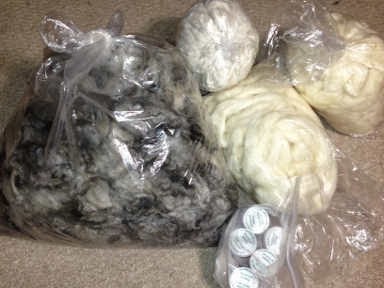
one seems to be fairly low in veg. matter and other contaminants and the varigated grey colour is spectacular.   The Tog or long coarser hair is very dark, almost black while the Thel or inner coat is so very soft and ranges from a light to medium grey.   It will be fun to work with, I'm certain of that.  There is also  Blue Faced Leicester sliver , some Merino/Cashmere blend rovings and some acid dyes.   Both cats decided that the Icelandic fleece was something to paw over and I had to hide it, at least until I get it washed up, nice and clean, not smelling quite so much of fresh sheep.

I finished up the chemise.  It was a quick project, only take a couple of hours to sew it up, including hand work.  It was really meant to be a wearable muslin so it wasn't made with expensive materials.  Good thing too as I don't really like it.   It misjudged the size so it's too large.  It's also too long, which if I liked wearing it and it fit, would be an easy fix.  Mainly, it has this weird, mandated by the pattern construction instructions, unfinished internal seam, which drove me buggy when sewing it up.  It's something that I've decided that I can't live with, so the chemise will become a nightgown and I'll find a better pattern.  No lace or tucks on the next chemise either.  It's just too much and unnecessary frou frou, for a garment meant to be used while working at the Bake oven.  


June 22, 2012

Washing Perrendale locks the hard way

Yesterday, I was having a bit of a brainstall when it came to spinning.  What I was trying, wasn't working in the least.  I was frustrated.  I walked away from my wheel and took a break.  I decided to do something totally different and picked up the bag of Perrendale fleece I'd purchased earlier this spring.  There is only a pound of it, but it is in lovely, long locks.  I've put off washing it as I wanted to wash it so it kept the lock structure.  That is a fairly time consuming job as I don't have enough space or supplies to do the whole pound at once.    I gently pulled a handful of fleece from the bag and separated each lock, laying all the tips in one direction and the ends in the other, on a square of fibre glass window screening.

I laid several layers of locks over one another.  If one is gentle with washing, the lock structure will hold, despite layering.  I pinned the packet together.  I did this 3 more times as I have only 4 pieces of screening.  I filled the sink with hot water and a squirt of dishsoap, soaking the packets without any swishing or agitation.  I did this 3 times and followed with 3 hot water rinses.  Then I laid the packets outside on the deck benches to dry.  It was hot out and muggy, but it should have still dried.  Later in the afternoon, the packets were still a bit damp, so although the weather had gotten hazy, we ran into town, with me totally forgetting my packets of fibre outside.  On the way home, it was obvious that I had misjudged.  The sky darkened, the winds picked up dramatically and we had thunder, lightening and a torrential downpour.  You could barely see on the way home from the heavy, blowing rain.  It was too wet  and too late to go salvage my poor little packets of fiber.

When the rain stopped, I rescued them.   They were flattened from the intensity of the rain and soaked through.  I pressed some water out of them with a towel and let them dry overnight inside.  Today, it's breezy, cooler and sunny. They spent the better part of the day outside drying, with me worrying about unwrapping a felted mess, since drying had left the packets flat and airless.  However, the first packet is dry and looks to be fine.  The long locks are clean, a bit lighter than I'd anticipated, but a lovely colour, even with the sun bleached tips.   It will take me  a number of days to get through washing the whole pound, but seriously, this will be used for some awesome project... I just am not quite sure what yet :)

June 11, 2012

More Practice

 More practice skeins.  I'm trying to get a consistent twist per inch as well as a consistent grist.  It takes a more refined drafting technique than I'd used before.  It's starting to get a bit easier, the more that I practice.  Fibre prep sure shows in some of these skeins.  They are all using commercially processed rovings and top.  Some are much nicer to work with than others.  There are samples here of both short forward draw worsted style drafting and a woolen style longdraw.
Before I set out for the course, I sewed up one block of the quilt I was planning for a Christmas present.  I knew that if I had even one block done, it would be the incentive to keep at the quilt blocks.  I did 3 more the other day.  They are 10 1/2 inch blocks, which will then be cut in quarters, to make a Bento Box quilt.  The light and dark centres will be set opposite each other, creating a bit of an offset optical illusion.  It's not my personal favourite pattern, but I know that several of my kids will like it.  I've a couple of other sewing projects which I'll work on as well, but it's a good break from spinning practice, both mentally and using different muscles and body positions.

Between times, I've gotten some gardening done, most things planted for now and even some weeding done!  I'm also on the second red/black sock.   While I like the finished sock, I will be happy to have these ones off the needles.

September 26, 2011

Spinning, carding and the dreaded laundry drama

It's autumn.  The weather has cooled off and it's been rainy.   The washer went on the fritz in the middle of a load of clothes, on a wet, miserable day and I had to wring out each piece of clothing by hand.  Of course I do cold water washes (brrrr) and I was washing heavy, linen camp clothes, so it was a more than miserable job.  I spent two days finding it's replacement, convincing the salesperson that if I couldn't take it home with me, I'd go elsewhere ( no, I did not want to wait a week to get the washer) and getting it home.  The evening of day three was allotted for hooking it up since it was raining anyway and not suitable for hanging clothes outside.  I'm finally caught up with the laundry..  yay..

 20m skeins of plied embroidery wools
In between laundry dramas, I was spinning.   I started off spinning East Friesian Milk Sheep fleece and ended up with some generic fibre blend sliver.   I'm supposedly making embroidery wools and the East Friesian just wasn't spinning up fine enough, although the bit of luster was really nice.   It's not bad, just not quite what I wanted.  The generic sliver was finer and as a result, I have a couple of skeins of really nice yarn.   Most of this will be naturally dyed sometime this week.
We were out and about on Saturday, mainly to Ealdormere's Coronation, an SCA event which was held in St. Catherine's.   It was a  lovely event but to get there, we have to drive by a small town called Jordan which is the location of The Fibre Garden, an awesome spinner's supply store.  As we drove by, I chose not to stop in on our way there as we were running late as it was.   However after the main festivities, my sweet husband whispered in my ear, that if I didn't mind leaving early, we'd stop in on our way home.  How could I pass up that offer?    They had mill ends on sale, which card up beautifully and Sari Silk - which I've been wanting to play with and Icicle top -which is a sparkly nylon you can add to fibre to give it a bit of sparkle/shine!   This is what came out of my drum carder..  please note, it's black, not grey but I was only going to fuss with the light for so long.    I've used about 10-15% Sari Silk and 1% Icicle sliver.  It's spinning up so nicely.   And I have to give kudos to the boys at The Fibre Garden, who make shopping there so much fun, are so accommodating and don't think anything of it, when you show up in weird medieval costumes because you left without changing in your hurry to get there before they closed.... and selection... phew, they have so much fibre there, it's amazing.

September 10, 2011

Jessie's Fleece

Jessie is an older Shetland ewe owned by a friend.   She got preggers by mistake and was darned near greeted by the reaper when giving birth.   She survived but unfortunately her lamb did not.   Shortly after giving birth, she blew half her fleece.  My friend hand gathered it and when she was sheared a few weeks later, bundled it all together.  She couldn't sell it so she donated it to our Regia group to use for dyeing in a demo we're doing this month.

I've washed it, twice as the lanolin and icky bits didn't totally wash out the first time.  It's soft enough, but because of the stress, there is a definite break in some of it.   It's also tippy and most of them are breaking off either by hand before I process or later when it's being carded.  It's a shorter fleece to begin with, so far the longest fleece I've found is about 4 inches long but most of it is much less than that.  Flicking only worked with the longer bits and still, it was hard enough with the breaks and tips.   I've had to resort to hand carding, slowly and carefully, to get it to be useable.  There are still some neps, a bit of staw and chaff that I just haven't been able to remove and a growing pile of bits I can't use. I'm thinking it's almost 50% loss so far :(


If I'd purchased this fleece, I'd be unhappy.  However, as a donated fleece for a specific purpose, it's not bad. At least it's a soft fibre and a nice shade of white.   It will dye up nicely and the two skeins I've gotten done so far, although having taken way longer than I'd like, will work up into something nice, at a later date.  I thought I'd left plenty of time to get a number of skeins spun up, but nope, so far only two and it will be all I can do to get a 3rd spun up this week.  I'd expected to have several more skeins to take with me to the demo, as I much prefer dyeing yarn to loose fibre.

May 27, 2011

Gah! More Stanley Cup Spinning

I'm officially getting tired of this project.  I realize what the problem is though.  It's just mindless spinning.  The past few years, I've become more specifically project oriented and just spinning for the sake of spinning is fine sometimes, but it seems like I've been spinning miles and miles of yarn forever, with no destination!    Well, the Stanley Cup Playoffs do seem to run forever, but still.   So, only one more game in the semi-finals and the finals start next week.  So in all, there are only 5 - 8 more games left.   With any luck, I'll be able to see it through and finish up what is turning out to be the nearly endless bag of roving!   The bag of white shetland that I'm spinning right now, while is getting smaller, doesn't seem to be doing so with any appreciable speed!  I think I've been at half a bag now for a week!
My original basket was overflowing with skeins.  I had to find a second basket.    It was much more impressive with the smaller basket overflowing with skeins, but honestly, it wasn't horribly practical.  It was spilling out all over the place.  I'd totally forgotten about the lighter grey, which was hiding at the bottom of the basket!  This is mainly grey, white and black Shetland.  The few skeins of white are tucked in the back.  I'm leaving them there because they are from a different fleece.   They are not quite the same texture or colour as the fleece that I'm spinning now.  The darker grey is Romney.    I've been spinning it all about the same grist, in hopes that if I want to combine colours for one project, I can do so.  

This is the moorit and the white Shetland.  The white is being plied using the jumbo plyer in order to get huge skeins.  With any luck, it will help me identify them as I go to use them.  There probably close to 1200 yards (plied) of the white.  I'm thinking that is getting close to a usable amount for something other than scarves or mitts.   I'd love to make a blanket from all this, maybe in a checky. It would be a good bedcovering for camping and Regia reenactment events.   But I'd have to sit down and do the math first..  recount the yardage on the skeins... work out the total yardage for the project and then the separate amounts for the checky pattern.  It probably seems like more work than it is.  I've been stalling on getting a project back up on the loom and not sure why.  I think I've got too many projects in the planning stages, which always slows me down.  I think I just need to queue them up and do them one at a time.

I started this bird design last weekend, while teaching a friend how to do the embroidery stitches from the Bayeux Tapestry - stem stitch and laid couchwork.  I brought it out once I'd unpacked but then set it in a work basket and covered it with a cloth.  What was I thinking, because I had to actually hunt it down this morning, having no idea where I'd hidden it.  I'm using stupid skinny yarn for this - Jaggerspun super lamb, so it's taking longer than I'd first planned.  However the first stitches I did in a thicker yarn, looked much too chunky for my liking.


Gratuitous cat photo 'cause he's just so darned cute when he sleeps with his eyes covered like that :)

January 12, 2011

A Method of Washing Fleece

On Monday evening I washed fleece.   Yummy, long stapled fleece from the the Pacific N.W.   They must be very happy sheep because the fibre is very nice; clean, long and strong.    I had two ziplock packets of just over 100 grams each -  4 oz. Imperial measurements.  There was a grey, which has totally seduced me colourwise, with it's sun faded tips and blue grey tone for the rest of it. I washed it normally, in the sink, with the regular precautions of no sudden temperature changes nor any agitation.  It turned out nicely     The other is what I think to be a Lincoln cross.   The locks were so well defined, even crammed into a ziplock, that I absolutely had to wash them carefully to keep the lock structure intact.  Just a warning, this is the technique that I always tell myself, I'll never use because it is too time consuming and fussy!  It is but sometimes....

First, I grabbed a piece of fibreglass window screen.  I keep several pieces for use in both washing and drying fibre.  I used the larger piece which was about 45cm x 90 cm (18in. x 36 in.).  I carefully separated the locks, or groups of locks that some seemed to be in.   I laid them out on the screening to make sure they were intact locks that I was working with and to see how much I had.   There are two ways to do this, one is to make a single layer of locks, package and washing each layer separately.  This method works well, but I find it somewhat tedious and very time consuming.  Instead, I layered the locks on top of each other.  If I had enough screening, I could have used a layer of that between the locks, but I've never really had much of a problem with just using two or three layers of locks at a time.

I packaged up the locks by folding the screening around it.  First, I folded the sides in, then the top down and bottom up.  I used little bulldog clips to hold the sides and two T pins to close the centre seam.  I could have sewn, tied or pinned the whole thing, but the clamps are easy to use and I could find easily find them since they live in my loom bench.  I only ever seem to be able to find 2 T pins at any one time.  I'm sure the house gremlins have huge hoards of T pins, pencils, pens, scissors and sewing chalk, in hidden places which I've yet to discover.

I filled a sink up with very hot water and a good squirt of dishsoap. I tend to use Dawn, because that is what the dishwishers in my family like (they WISH we had a dishwasher!), but any good quality detergent will do, even laundry soap if it doesn't have bleach, optical whiteners etc. added.    I gently pushed the fibre packet into the hot water and let it soak for about 20 minutes.  I removed it, squeezed it out gently and redid the process - once more with hot, soapy water and two rinses.  

I opened the packet and spread it out on my nifty fleece drying rack. On a recent trip to a certain Blue and Yellow Swedish Box store, my sweetie suddenly said in a loud voice to catch my attention  " look, a fleece drying rack"  and poof, it came home with me.. good man...   I think maybe it was originally supposed to work for laundry, but it's fairly lightweight and I wouldn't want to dry jeans or towels on it.   But for fleece and yarn?  It's perfect!   I did have to spread the screen out underneath the fleece to keep it from slipping through the openings, but I'd  do that on the deck anyway.

Of course having washed fleece in the winter, with our dry winter and dryer wood stove heated air, setting up the rack in close proximity to the wood stove and fan circulated air, helped it dry very quickly.   It was easy to separate each lock.  This will be so fun to spin.