This is a nettle patch which started growing in one of the gardens. I've been wanting to try processing nettles for several years. I got started once, but realized how many nettles it would take to actually make an impactful project, so I've never gotten farther than a bit of research and chopping a few down.
This past week though, I donned some leather work gloves, jeans and long sleeves even though it was 29C with a humidex of 33C or something like that. If you try this at home or the edge of some wooded area, please wear long pants and long sleeves. Nettles have little hairs which are hollow and filled with an irritant. If you even just gently brush the plant, you will get an intensely sore, red, welted area, which will last for hours. Cold water and aloe help somewhat. Apparently so will plantain, but I didn't find any until my welts had faded :)
There are several different ways to process nettles, and not a lot of information on how this was done historically, although we know that nettles were used as cordage and in textiles for a very long time. I started off with a method which is considered to be a possible prehistoric method.
I used secateurs and snipped each stalk at the base. With my leather gloves, I ran my hands up the stalk to removed the leaves and flatten the evil hairs. I ran my gloved hands up and down a few times to make sure the stalks were safe. Once the leaves and hairs were gone, then the nettles were safe to handle bare handed. You could use a piece of leather for this. I tried that, but it was much easier for me to just use the leather gloves.
The next step is to take a hammer, dowel or a stick and gently tap the nettles to start to break it open. I found that one could be too gentle and the thick stems required a bit more force than I anticipated. I used a hammer because I found one that had been forgotten in the barn. It seemed a good thing to rescue it and put it to work.
Once the stalks were cracked, I slit the whole stem open by running my finger or thumb up. Then it was supposed to be quite simple to crack the inner pith, break it back and peel the bark off.
It wasn't difficult but it did take a little bit of time. Nettles have a segmented stalk and while the fibres are long, they are attached at each segmented node. I had to ease the bark off these nodes. This took the extra time.

After about 4-6 stalks, I had this little pile of fibres. I was hot, and bored. If I wanted to prep the fibres for spinning, I would have to then scrape the bark off. I decided that I didn't need to work the pre-historic method of prepping nettles.
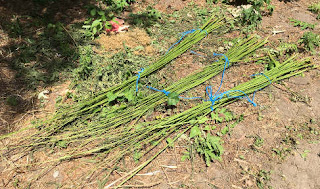 |
| re-using bale twine to bundle the nettle stems |
Instead I would try dew retting the nettles. I snipped off all the nettles I could find. I stripped the leaves. When each stalk was stripped of it's leaves, I lay it in a pile in the sun. Once I had enough nettles prepped, I tied them in two places with figure 8 ties, stood them against a fence to dry a bit overnight. The next day I lay the piles on the ground. I plan on wetting them down twice a day. While it rained last night, we've really had a near drought summer, with really warm weather and very little dew. This way I can try to help mother nature along. I don't think I will get any more fibres, but I will hopefully end up with some useable tow as well. If all goes well, the dew retting processing should take 2 - 3 weeks.
There is a lot of conflicting information out there about processing nettles. The process I'm sort of following at least showed some usable fibres at the end of it. I realize I'll have a very small amount of actual finished fibres when done. With all the work I've put into it already, I'm thinking that I can see why flax became a far more attractive fibre. Even though flax is a lot of work to process, it is still less than flax and not so dangerous either. Next year maybe I'll remember to order my fibre flax seed and can do a comparison.


