Pages

Showing posts with label washing fleece. Show all posts

June 13, 2026

washing and processing a new fleece

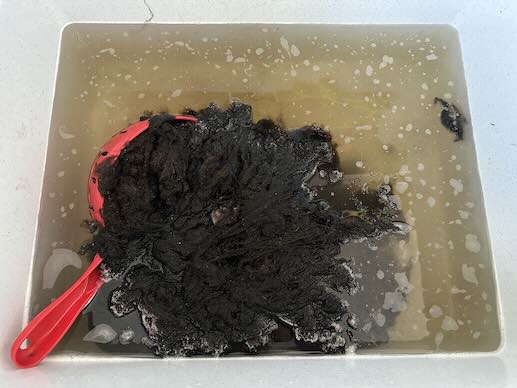
 I've been washing fleeces.   This one is likely a BFL/Shetland cross.   It's about a 3-31/2 inch staple length.  There is a bit of VM, which is to be expected since the sheep are kept outside all the time.  The worst VM I've ever found came from sheep who were kept in a barn almost all the time.  It was just loaded to the point of almost being unusable, especially when combined with the excess lanolin produced from being sheltered all the time.   

This fleece was easily cleaned. I put portions of the fleece into lingerie bags. I used my laundry tub to soak, with no agitation for any of the soaks or washes.   I used a warm water soak to remove a lot of the actual dirt.  Then I used a hot water wash with Orvus paste and Zep degreaser, which removed most of the lanolin.  The second wash was just Orvus and a tiny squirt of Dawn dish soap in hot water.  It needed 2 or 3 soaks in decreasing temperatures of hot water.  As the water cooled down during the process, I used the next water bath at a similar water temperature as the previous one had as I drained it.   Since the two factors for felting wool are agitation and abrupt changes in temperature, this would hopefully stop that from happening.

I tried a batch in the drum carder, but didn't like the results.   The VM doesn't generally fall out in a drum carder, usually does when spinning.  What I had missed was that this fleece was a bit tippy, meaning the tips were weak and were either a bit felted or they just broke off when processing, and there was a bit of a short undercoat and some felted cut ends.  These caused a lot of neps to be formed in the drum carded batts.   I tried combing with Valkerie viking combs, which produced a stellar result but about 25% waste, which is pretty normal.  The problem that I found though was that required a lot of arm strength with the felted tips and cut ends.  I ended up flick carding the locks and turning them into rolags, which resulted in minimum waste and a lovely, spinnable rolag.  It's still a lot of work though.

I learned something.   I'd been taught early on that flick carders work best using a tapping motion to create static electricity, which opens the lock and lets the VM drop out.  This technique works exceptionally well, and doesn't take a lot of effort since it's just a gentle tap, tap that's needed.  However, this works until it doesn't.  With the weak tips and the bit of felting at the ends, that brushing that I've always warned people not to do, is totally required here.  The tips need more effort than the tapping allows for and the felting at the cut end, despite being really slight, doesn't respond at all to the tapping.  This means that I was tapping away and accomplishing absolutely nothing!  So I resulted to a mixture of brushing the tips and then tapping.   Takes more time and much more effort but I was able to get those beautiful rolags that I like to spin.   It's going to take me forever to process this fleece at this rate.

Now if only I had labelled the lingerie bags that I'd used to wash the 2 white fleeces in.   They are all the same bag, as in the same colour, the same size, the same everything and when filled with white fleece, yup, they look all the same.


June 05, 2026

Beaded Dorset Buttons

 All the peppers and tomatoes are in the pots.   All the flowers for the deck are planted, although I just realized that I've been watering Geranium cuttings all winter, and I have an empty hanging basket that I should pop them into.   I just found out why the parsley plant didn't do well last year, and not only because of the swallowtail butterflies.   There is a chipmunk that likes parsley and I see him at the planter, nibbling away at the leaves and stalks!  It's supposed to be rainy on Saturday, so I've planned for some time on Sunday to finish up planting the seeds.  Beans, cururbits, Kale and chard on deck please!


I was playing around with Dorset Buttons a couple of nights ago and learned how to add beads to my buttons.  There is a rug hooker that does Dorset buttons as well, but she uses heavier yarns and larger rings to make them.  She adds all her beads after the buttons are finished and just sews them on.   I didn't think that would work with my buttons.  The Dorset buttons I make, are smaller and with finer threads, so I learned several different ways, including adding them while winding the spokes and sewing them on afterwards using  3 different methods. I'm pretty pleased with my first attempt.   I used Perle cotton and some nice glass beads.   Next time I'm at a textile store, I'll check for some beading needles with larger eyes, just to make things a little bit easier. What I had worked adequately, just not as easily as I'd hoped.

This is another attempt with Perle cotton and glass bugle beads.  It's smaller than the blue button.  I think the ring was too small for the space the bugle beads take up, as some of them are pushed down a bit.  Auto correct keeps trying to make it seem like I'm using Beagle beads, rather than bugle beads, which is kind of funny.   Apparently bugle beads come in different diameters, which seem to vary by very small amounts, like .2mm, .4mm, .7 mm larger.  Really, it might be fun to try, but I'm not in any hurry to source these as I can't imagine that what I made wouldn't work for most purposes for which I might need it.  These work fine for me.  Gina B Silkworks has some interesting button tutorials on YouTube, which are really well done.


FLEECE UPDATE: I've two lovely white fleeces washed already.  I have the remaining 3/4 of the Icelandic fleece washed.  It was a really enticing grey, but I didn't enjoy spinning it.  I gave some away and I'll try again with the rest.  I washed up a bit of New Zealand merino that I've been carting around for a while too, just to get it out of the way.    I've a fabulous black fleece and two more white fleeces to wash, as well as half an amazing cria (baby alpaca) fleece that I can't wait to work with.  Guess what I'm doing this summer?

May 10, 2026

Colours of Mother's Day


Fern in our garden
It's Mother's Day today.  It has been a sunny but cool day, with a wickedly blustery and cold wind.   There are little leaves on the trees.   More so in town, where I was taken for lunch, where the climate is just slightly warmer I think.   We were supposed to have a picnic in the big park and watch the ducks and geese, but there was a base ball tournement, and most of the ways in were closed off.  We went to go to the other park, which is along the Thames river, but construction blocked off the main route to the park entrance.  Eventually DH wound his way through side streets to find a way into the park.   It turned out to be too cold to eat outside, and there were no ducks or geese, but it was still nice.

Washing a very nice fleece 
I'm teaching a small class about processing fleece using different methods.  I had lots of short fibres for learning to card with.   It's a crap fleece, so students will have lots to practice with and not have to worry about making mistakes. 

 I also have an absolutely brilliant Icelandic fleece.   It's labeled as a black/grey moorit.  However moorits are usually in reference to a shade of brown from pale beige to reddish brown and this is definitely not that.   However the tog is a pale grey and so very soft.  The Thel is black and darker grey.  It's stunning in colour and a very nice Icelandic fleece.   However, I have discovered I'm not really thrilled with spinning Icelandic fleeces, so I'm donating it to the class, so we can practice dealing with double fleeces.

Finally, I had nothing long enough to comb.   I asked a shepherd friend if I could purchase a fleece suitable for teaching combing, and she gave me 5 fleeces.  One was given with the caveat that it was for me and not for teaching.  It's almost solid black, with some weathered brown tips which will give the yarn character when processed.


What did I really do all Mother's Day?   Except for the lunch break, and a trip to the dollar store on the way home to pick up lingerie bags, for washing fleece, I washed fleece.   I did half of a fleece suitable for combing, and half of the Icelandic fleece.  The other half of the Icelandic fleece is soaking as I write this.   It has been a very fun day and having my guys cater to my need to wash fleece (the class is next weekend) has been very nice.

Yesterday I was at a crank in.   That a gathering of circular sock machine knitters.   We drag out all our heavy metal machines, tables, accessories and sock yarn, to socialise, watch demos and of course purchase supplies, all in a situation unconduisive to actually being productive.   There is usually some sort of charity donation.  The past few years it was Izzy dolls, donated to the local police department for use in kids trauma situations.   I had 26 dolls hand knitted by friends and 6 I'd made myself.  In the past couple of years I've made more, but they are a lot of work to finish up and I 've been spinning, knitting up that yarn, and weaving more, leaving little time for the fussy handwork of the machine knit comfort dolls. Still between my friends and I , we had the most donations!   I also won a door prize, and the donated yarn wasn't taken yet, so I snagged it.  It's really pretty.   Despite the winning of a door prize, I think most crank-ins are really good learning situations.   Crankers are very generous with their knowledge and help others.   I met some really nice people and had a lot of fun.  


April 27, 2026

Just some little things


The garlic is liking this changeable weather.  This photo is from a few days ago.  I took one today, but it was really early in the morning and the shadows made for an interesting but not horribly useful photo.  So the garlic is currently larger and happier than even this.   It's still April and growing really well.  It will be ready to harvest sometime in mid July more or less.  In the meantime, I'm waiting to harvest the scapes which won't show up for weeks yet!


The weather has been very changeable.  It's gone from hot, to cold, with rain, snow and a bit of sunshine.  The Scilla lasted only a few days.  The Daffodils lasted barely a week.  They are just stalks with faded flowers now.   The Alliums are growing well, and already have little buds on them.  They may be early too.   These tulips are the only one's I've seen so far.  The squirrels may have gotten the rest.   Two days ago the blooms barely had any colour and by tomorrow they should be in their full glory.  I wonder how long they will last?

 I have a few teaching opportunities in the next few weeks.  One is a class on processing fibre with various tools like combs, cards, flick carders, drum carder and wool hackles.   However to make this work, I'm washing up some fleeces so we have 2 different kinds, single coat and  double coat fleeces to see how they work differently.   Right now I'm washing a Dorset cross fleece.  It's shorter than I expected so it may be pure Dorset, or Dorset type.  I spun up a fleece of this kind last summer and it was actually pretty nice.  This one is obviously a sheep that liked to roll in icky, muddy, poopy pastures. 

1st cold water soak for washing a Dorset fleece

Ive been doing a cold soak for the first bath, to get rid of the dirt.  This doesn't remove the lanolin, which requires heat.   It does get rid of the actual dirt, mud, some of the urine and feces.  I do the next wash in very hot water, with some orange degreaser and Orvus paste.   By the time this second wash is done, it usually just takes a light third washing, to remove any last stains or stubborn bits.   This stuff is so dirty, that it took a second and third bath in hot water, Orvus and I added some Dawn dish soap.   It only took two rinses though which was nice.   Partially I think because the soap bubbles were backing up in the sink and I had to let the rinse sit for quite a while.  It's not perfectly clean, but clean enough to use.

I have more of this white fleece to wash and then a very pretty Icelandic fleece to wash up.  It's a double fleece and it's so pretty.   I'm just not fond of spinning it, so will sacrifice it to this class.   This is needed in about 3 weeks.

Then I'm doing a nature dye class in June.   A friend gave me a poke to remind me to get on the ball with the planning, so between it, and the SCA event FOOL that I'm doing, plus my son's wedding, it's getting a bit crazy around here.

June 07, 2025

Fleece Prep Steps


I've been working with the Dorset/Friesian fleece that I was given. It's not a super long staple length,  or super soft, but it is long enough mostly just over 3 inches  and soft enough to make it fun to work with and really nice to spin.   The first step to processing a fleece is washing.   I've taken to doing a cold water soak to remove and loosen the dirt before washing with soap, degreaser and hot water to remove the remaining dirt and the lanolin.   It's worked beautifully in getting the fleece very clean, using fewer hot water washes and rinses. This is the cold water soak I started earlier today.   It's amazing how quickly the dirt starts to soak off.  The water is really, dirty now.   I'll drain it and wash it tomorrow.  After an overnight soak, it should be good to go.  I don't want to leave it too long or it will start fermenting.   This is good, if it's not in your laundry tub, in the back room of your house

I set up my laundry rack on the deck.   I have a roll of fibre glass window screening that I spread over the top bars and spread the fleece out to dry on top of it.   If it's breezy, I put another piece of screening over top of it and peg it down with some clothes pegs to keep the fleece from blowing away.   A bit of breeze will help it dry quickly, as does using a salad spinner, laundry spinner or even just putting the fleece in a mesh bag and whizzing it around quickly in a circle to extract the extra moisture.   It was nice enough out that this dried in a few hours.  I did check it part way through and pulled the few damp spots left, to expose them to sunshine and air.   It was all dried well before supper time.  This was good as I needed to have it for the spinning gathering the next day.  


The fleece does have a bit of vegetable matter, mostly bits of hay that are fairly easy to remove.   The worst VM that I've experienced was either in some Shetland fleeces, from barn kept sheep which was overwhelming to pick out, or the Jacob fleece I was given that had huge bugs in it,  Keds I think, and they were dead but oh, that was so unexpected and awful to deal with.  I gave the fleece back!

Anyway, much of the VM falls out while carding or pulling the locks apart before carding.  The rest mainly falls out or can be picked out while spinning.  The few bits that remain, are just part of the process.    

I've been mainly hand carding the fleece.  Although it's a little hard on the hands due to repetition and arthritis, it is still a lovely preparation.   I've put a bit through a drum carder too, which is faster, but a bit different to spin.   The skein is my sample and the bobbin is my next try at a slightly thicker yarn.
Short forward draw, not counting really, but 1 treadle per about a 1 1/2 inch draft.
This is my second sample.  I did two full bobbins and plied them together.  It's a slightly thicker grist that my first sample and will work for a sweater.   I'd planned on dyeing it after spinning as I don't know what colour I want yet.  Then today I started second guessing myself, thinking that I should have dyed it in the fleece and carded it together for a more even colour.  I'm almost finished another bobbin though, and have the remains of the second one as well,  so do I knit a patterned sweater?  Maybe a simple fair isle type design?   Or do I keep going as I've started.  

  Regardless, it's fun doing. a big project like this with a fleece this nice.   I got a bit distracted and a bit burnt out from the Master Spinner class, spending 6 years spinning to class requirement.  I've heard this is an issue with a lot of people who do that course.   However, having people to spin with again has re-ignited my passion for spinning, which I'm so happy for.    Now to find a knitting pattern for my new sweater.


June 02, 2025

A Crazy few weeks, but still things get done.

 What odd and icky weather we've had.   Sunday we had frost warnings and apparently there was a frost delay on the local golf courses.   It's been cool, so cool that we've had to run the wood stove until the very end of May, which has never happened before.   Today though, was lovely and I got to hang laundry, dry fleece and spend a lot of time outside, without a toque, mitts and sweater.

The garden is half planted.  The beds aren't warm enough yet to plant the beans and I'll need to get a few more onion sets as a raccoon got a few the first night I planted them.  I've now got towers of tomato cages protecting freshly planted seeds and seedlings.   I've a couple of pots left to clean out and have a few more bags of composted manure to spread.  The cool weather though, means that everything else I'd like to plant is delayed anyway, so I'm not really behind.


Today I saw this pretty butterfly that I identified as an Eastern Swallowtail. It was gathering nectar from a late flowering lilac bush, a Persian Lilac.   Its scent is different from a true lilac, but it always flowers.  Since it flowers after the true lilacs, it nicely extends the season, which is good for extra colour in the garden.

I've started washing Dorset/Friesian cross fleece that A gave me.  The first batch was done my usual way, which was 3 washes and 3 rinses.  It works well and the dirt and lanolin was all gone.  Today, I soaked the fleece in water for a couple of hours before washing it.  I was going to  soak it 24 hours, but then A called up asking if I was available for a spinning day tomorrow.  To make sure I had enough fleece to spin, I drained it, washed it twice and rinsed twice.   Instead of using my salad spinner to spin out the water, I whizzed the laundry bag of fleece around outside.  I was amazed at how quick and effective this was.   I laid the fleece out on the deck,  between sheets of screening on a laundry rack.  It dried in just a few hours.  I've now run a few bats through a drum carder to use tomorrow!


It's really dark black, not grey.

I made a hat for a Christmas present for my daughter.   It's black.  I was going to make black mittens to go with it, but have decided that I really don't like knitting with black yarn that much.  It was commercial dyed black and the stitches were so difficult to see.  I think I started it 8 times before I bought a new, very short needle to make it work.  I'm very happy with how it turned out though.  I over exposed the photo so that the pattern could be seen, because it looked solid black otherwise.

The grey and black sock yarn scarf is off the loom and needs to have the fringes twisted and to be wet finished.   I'm not going to pass judgment on it yet, as I think wet finishing will remove the spinning oils and could end up with a different feeling project.


The SCA A&S event on the May long weekend was a success despite a bit of rain and some very cool weather.   It took me almost a week to unwind from it, which is mainly because I picked up a couple of good novels,  an Ann Cleeves mystery and a hilarious sort of romance by R.J. Blain.   I do enjoy a few days just to read.    


February 12, 2025

A Rare but little rant

 I went over my friend's to try out her new huge electric carder.  It's double width at least of a home carder and has dual speed adjustments for the licker-in and the main drum.   She's worked out a spiffy way to draft off roving instead of batts, using a little bead as a diz.   It works amazingly well and the resulting roving is very professionally done.   It's light, fluffy, and easy to spin.


I brought the last of my bag of merino/cashmere/silk/nylon mill ends which were too hard to spin without processing.   I'd been hand carding them, but was frustrated enough to think about digging out my drum carder, when this play date came up.   It took a while, because it's still a fairly slow process, but what an amazing job.   I think we ran them through 3 times and we ended up processing just over 300g, into 3 huge bumps which filled 1/3 of a large plastic bin bag.   It was beautiful stuff.

I'd actually brought the mill ends in case we needed something else to card, as we were going to work on the black guild fleece.   The guild fleeces have turned into a rant worthy project.   I was away on holiday, so someone took my place on the field trip, to get the fleeces we were offered.  I'm hoping they didn't have a choice because that would make things much more acceptable.   We were supposed to get 5 fleeces, but the gal picking them up took one.  That's fine, because 4 fleeces is a lot of work so spreading the load is a good thing.    These are the fleeces that I was told weren't for me to work with during the summer and if they needed my help, they'd ask.   "Whatever"...still ticked me off, as I had the time and space to work with them then.  Anyway, in the fall, I got the rest of them as the person gatekeeping them decided she was tired of them and going to store them in a warm, dark spot - moth haven.   

The first fleece we had access to was washed by someone with little experience.   She was happy with her efforts, but there was still so much lanolin in it.  Plus with just a gentle tug, we found that a good part of the fleece had a break in it.  If you take a lock of the fleece with one end in each hand and give a tug on it, the fleece should hold together.  With a break in it, it will snap into two shorter pieces.  It's an unsound fleece and horrible to work with.  After you check the staple length, this is the next test to do, in several places. Not only that but parts of the fleece were felted.  A thinks that both issues are due to dunking and lifting a mesh bag of fleece during washing, instead of letting it soak openly.  So A took it home to rewash, and see what she could do with it.   She ended up trying to card it, then comb it and almost gave up.  With the new carder, she made something useable but only after running it through the electric carder 5 times!  It's a nice-ish knitting yarn, very rustic due to the ness, in a worsted/aran weight.   

The second fleece is also white but I washed some up with multiple washes and rinses.  I couldn't hand card it.  Literally was too compacted or felted to hand card.   It was a miserable mess on a small drum carder with coarse cloth.   I had to comb it and it was about 70% loss of fleece to useable fibre.  Not only that but it was hard on the hands, so not worth it at all.   I gave the washed fibre to A too see what her thoughts were and she couldn't get anything good out of it either.

The third fleece is a lamb's fleece with so much lanolin that 5 washings with soap and degreaser still left the fleece greasy.   I figured another wash would felt it up, just from overworking it, so I left it with A to see what she could do with it.  I'm sort of wondering if it should just be turned into compost because no fleece is worth that much time, effort and resources to process.

The  last fleece was the black one.  Of them all, it's by far the best.   Apparently someone washed it
before I got it, but that was the one that required 3 more washings and 3 rinses to actually get it clean.  We carded up just over 200g, into two bumps to see what our thoughts were for spinning this.   I'm half through my bit.  It spins up fairly easily.  There are many more neps than I'd like in it and not all can be picked out when spinning.  This means it's a lot thicker yarn than I'd normally spin with something like this.  It's full of vm, way more than I'd anticipated.   

If the guild was hoping we could spin up yarn for them to weave with it's going to be a non-event.  We've both already talked about how these fleeces are so bad that because of the number of hours required to turn them into useable yarns, that the people spinning them should have first dibs on them.  I'm not sure who would want to put that many frustrating hours into making a small amount of yarn, to give away to someone with no idea what went into making it.

Also, if someone gives you fleeces or you buy them, you have the right to check them to make sure they are worth the amount of work needed to make them into useable yarn.  I've gotten fleeces from the Canadian Wool Co-op and straight from the farm  which required only a couple of washes and rinses to bring up bright, easy to use fibre with almost no vm.  They can be a joy to work with.   Before you put your money down, you should be able to check the staple length and the integrity of the locks before you buy, or at least have an honest description from the seller.

January 27, 2025

Washing Sheep's Fleece

Generally these days, we wash our sheep's fleeces before carding and spinning.   Greasy fleeces used to be a "thing", especially in the 70's when there was a crafty revival and people were teaching themselves crafts without all the resources we have today.  However, spinning fleece in the grease generally leaves your equipment dirty and it's a pain to clean.   Why am I writing this post explaining this and more?  Because today, while finishing washing up the last of the black fleece, I came across a little note that had the date the fleece was skirted and then a small added scribbled "washed" below it.   I didn't realise the fleece had been washed already.   Yes, there was less lanolin in it than the other two fleeces.   However, it still had some lanolin and it was obviously dirty.   While this fleece may have been washed, it wasn't washed properly.   I'm going to explain a simple way to wash fleeces.  There are other ways to wash fleeces but this is a pretty basic method which is effective.

First thing to know.  Lanolin needs hot water and soap to be removed.  The water needs to be at least 120F, to "melt" off the fibre.   A bit hotter is better so that you have some working time.  If the water cools too quickly, it may settle back on the fibre.   If your hot water source isn't hot enough as some water heaters have safety measures of lower temperatures, you need to heat up water on the stove or in your kettle to add.   While I'm using a laundry tub for this demo, this applies to using your top loading washer if you're using it to soak and spin your fleece.   

Washed fleece should not be this dirty!
Next you'll need soap.  A high quality dish soap like Dawn for Fairy, Orvus or other quality animal shampoo or a wool wash.   I don't use wool wash because it's way out of my price range, but I've seen some results and it works well.   I also use a citrus degreaser in the first and sometimes 2nd wash.  I use Zep,  because it's available locally, in 4 litre containers at the big box hardware store and smaller amounts available at a local hardware chain.  This is effective in the first wash to help remove the lanolin and some of the excess dirt.  I usually use a glug or two of Zep and about 2 or 3 tbsp of Dawn in the first wash, along with only hot water.

Remember -  felting is caused by 2 things.  First, is agitation.  Be gentle when you move the fibre through the water.  The second, is temperature changes.  It's not hot water that shrinks sweaters, but going from a hot wash to a cold rinse, or the agitation cycle of the washing machine.    You always need to be careful that the water temperatures remain close to the same, or if you leave for a while, that you use the same temperature water as you just drained out.


Start the hot water and add the soap and degreaser, or wool wash.    Once the tub is full, gently press in some fleece.  Don't over load the tub.   You want enough fleece to be a full layer, allowing enough depth in the water for water to move through the fleece and not be bogged down with depth. This will help get the dirt and lanolin out of the fleece.  It usually takes several washings to get the dirt out of the fleece and then several rinses to remove the soap.  I found so many short cuts  and neppy bits with this fleece that I ended up repurposing my little strainer to scoop up as many bits as I could.

Non-scientific explanation of how the soap does it's job when washing fleece -  When the water is hot enough for the lanolin to melt and has enough soap etc, the lanolin gets attached to the soap and the soap gets attached to the water.  This means when you drain the tub, the lanolin gets washed away with the water.   The soap is hydrophilic and hydrophobic which is the science stuff you need.  The soap will do the same to a lot of the dirt.   

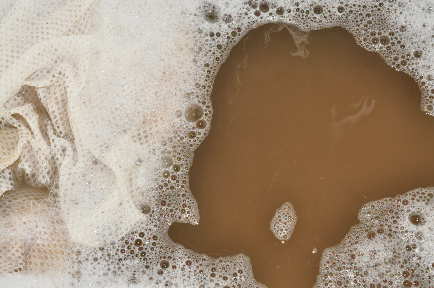
Once the wash water is clear or at least clearish, you can start rinsing.   Remember the water temperature should be similar to what you just used.   Washing should be in hot water, but rinsing just needs to be in similar temperatures to the water as it's cooling down.  Here you can see that there is still soap in the water and some dirt  or dirty water being removed, so it will need another rinse.

Once the rinse water is clear and not soapy, you're almost finished.  Now you need to gently squeeze out the excess water.  You can do this with a towel, or if you have a mesh bag, you can put the wet wool in it, go outside and use centrifugal force by whizzing it over your head to remove the water.   If you have. a fancy extractor that works well.  I have an old lettuce spinner which does the trick, although it's a slower solution.  

Dirt left in the bottom of the tub, from the supposedly washed fleece.   Just no-  this will muck up your hand cards or drum carder.   If your fleece has this much dirt left in it, you need to wash it again!

I'm a bit ticked because I shouldn't have had to rewash the fleece, if it had been done properly in the first place.   I'm glad I hadn't noticed that it was supposedly washed because I would have hated to run that through a friend's equipment.  


January 24, 2025

more project updates

The shawl is finished.  It was an easy pattern to remember since it was all garter stitch and increased 1 stitch at the start of every other row.   Once I had the stripe pattern done once, it was all that was needed to refer to once in a while.  Most of it was self explanatory.   I am sort of thinking I should have gone for the blue for the dark stripe like the pattern suggested but I'm happy enough with what I chose since I already had some of that dark brown/grey wool on hand.  I didn't add the fringe because it would have made the shawl less useful for warmth while doing things.  I just did a single row of double crochet along the edge to tidy up the side with all the yarn joins.   This pattern is in Peterson's, 1862, jan - June, pg 419 or so.


I was also knitting this bunny toy at the same time.  Well I'd started the bunny, set it aside while I knit the shawl and am now finishing up the bunny.   It's a large toy and it's taking a while to knit it, mainly because by setting it down for a while, I started knitting again at the wrong gauge.   Now I'm having to re-knit some of the pieces so that they match properly.   I just finished my 2nd set of arms.   I have the body done, 2 arms done properly, 1 leg.  I will start the second leg tonight hopefully and then re-knit the head which is the fussiest part.   It's the wrong tension though and looks odd with all the other pieces. 

This bunny takes a lot of knitting.  It's done on straight stitches so takes even longer.  I'm using handspun merino/cashmere/silk so it's really soft though.   It has knitted clothing as well.  I'm going to dye up the body pieces when I'm finished knitting them but before I sew and stuff them.  I'll also dye the clothing yarn at the same time.

Ashleigh got a new drum carder and want to play.  Since it's a spinning day next week, I'm washing up


some guild fleece to try out.   The guild was given 4 fleeces to play with.  The gals who picked them up were hoping we could spin them up for them to weave with.  However, they have no idea how much work that will be.   I'm not sure if they checked the fleeces when they got them, or even if they got to choose them.   The gal who was gate-keeping them finally let me have access when she was tired of storing them.  I just tossed them in my garage where they will be cold enough to not get moths all winter.   

However, in washing them up, one fleece turns out to have a significant break in a good part of the fleece.   Ashleigh has been playing with that one and with her new drum carder has gotten something useable in 5 passes - that's a fair bit of work.  The lamb fleece is so short and so much lanolin that I've test washed some and after 3 washes with soap and de-greaser, and 3 rinses there is still so much lanolin left in.   The other white fleece is meh- full of neps and lots of dirt and sand.   I couldn't card it but had to comb it with over 50% loss.   Not fun at all.   This is the last fleece, the black one.  It's really black and night time lighting doesn't show it up.  It it cards up it could be a nice enough fleece, but with the others being such as they are, I'm not holding up a lot of hope.  However, having a nice large carder to try it out with should be fun.

There are tons of second cuts that I've been picking out while washing.   I also heard a rumour that the farmer has sold off all its sheep because they couldn't get their wool processed in a timely fashion.   Some of the small mills around here have ridiculously long waiting lists, so I can understand the frustration.  It's nice having the skills to do it myself if I need to.

January 08, 2019

Busy work for those long dark days of winter

Much spinning has been happening.   The white is some regular BFL.   I've now got a bit under 500g spun in a similar weight.   The pink is one of my fall dyeing experiments which is mainly pink and purple, with some decent bits of blues and mauves.   It's a superwash BFL.   Both spun up nicely and when I sit down to it, quite quickly.    The white is about worsted weight while the pink is really fine and should be somewhere in a light sock weight/lace weight.

I've gone on a bit of a wool washing binge.   I don't really like to wash fleece in the winter but this is a medium grade fleece of unknown origin and I have need of something less fine that all my pre-processed fibres.  It's really too coarse for wearing close to the skin.   I'm going to spin it up for rugs, so it's perfect for that.

This is the first wash water - ugh, it's really, really dirty.   It's only taken 2 washes though to get the fibre clean.  The first batch only took 2 rinses as well.  It's fairly low lanolin, which really helps.  The second batch though, I used too much soap, so it's going to need a couple of extra rinses.  It doesn't take that much extra actual physical time, but does take up a lot of waiting time.

 There is lots of VM in it so I'm thinking this will be run through combs for processing.    

Kevin has been inappropriately interested in my large trash bag of fibre and it's been a chore to keep him out of it.   
I took a rug hooking class the other day.   I finished the actual project, except for rolling the edges.   It was a lot of fun.  The black wool strips were cut a little bit on the bias, so they were very shreddy.  It made them fluff up a bit and combined with my lack of experience, made my sheep's ears disappear.  Still, I'm happy with how much fun it was and how quickly the learning curve was.  The class was pretty good and covered lots of information.  I think the only things missed were different ways to hold the hook, in which it was mentioned but never demonstrated, and how to actually tension the fabric in the hoop, which may or may not be an issue if you get it tight enough to start with.

  I'm going to spin up some yarn to use for rug hooking, as it seems like a good way to use up bits of yarn and fleeces which may have no other use.   But if you have scraps of real wool fabrics, I'd love to have them.  They don't have to be awfully large as there is lots of shading and dyeing of mixed lots to make up the unique colours.


May 30, 2018

Catching up two weeks worth of stuff

Argh - I've been trying to post for days, but there is always something which has distracted me so I'm sitting down and just doing it.  Actually, I'm supposed to be dressing the loom right now.  That was the plan, but I didn't get the rest of the warp wound yesterday.   I'm waiting for a delivery of dirt - a dump truck with 4 c yards of triple mix actually, to fill raised beds.   The only place I can see or hear the truck come in is in the living room.    If I had the warp wound, it would be perfect, but my warping board is permanently attached to a basement wall, so I wouldn't hear the truck.    I need to be able to show them where to dump the dirt and not have them dump it on the driveway!
So FOOL, or Fruits of our Labours was fun.   The weather was undecided.  It was very cool at nights, rained in the morning and had enough glorious sunshine to make us forget the rest of the weather.   There were some awesome classes.  Sir Edward ended up having enough time on his pole lathe to make this bowl.    Since my phone camera is acting up, this is the only photo that I took, which turned out half way decentlyOnce I got home, I did laundry - oh,always so much laundry after an event - got rested up and then caught some nasty virus or something.   I spent some time looking for a stainless steel rectangular roasting pan to dye with.   Way too expensive right now as the cheapest I found was $99.   I checked on line and local stores.  I even checked thrift stores to no avail.   Not sure what the next step will be, but I do want to try some of these new techniques for modern dyeing that I've read about and watched.   


I did take advantage of the hot, sultry and very abnormal May weather to wash up some fleece.   I emptied the bag with the lamb's fleece.  It washed up nicely.     I've started on the box of remaining fleece from my Master Spinner in-depth study.   That was a huge fleece for sure!   Not having a good way to wash large amounts of fleece in the winter, being able to dry it outside is a boon to productivity.   It does take time though, 3 washes and at least 3 rinses.  It takes a little longer using the laundry sink instead of a basin, but I can do so much more at a time that it's worth it.   

Otherwise, I've been playing in the dirt. I've got two pots of Japanese Indigo planted,which are loving the hot weather.  The Dames Rocket is flourishing in the Winter Onion patch!  I made Rhubarb/Apple crisp - yum.   The deck planters are almost filled.   I need another trip to the garden centre for a couple more plants.   

The  seeds for the raised beds have been purchased.   I also found two awesomely nice looking blueberry bushes for only $8 each, so they came home with me.  One will replace a sad looking blue berry bush which never really grew well and the other will go on the other side of the bush beside it or they'll go in the front flower beds.   I haven't quite decided yet. 

The red currants and gooseberries are already heavy with green fruit.   If the weather holds and the birds don't get them, we may have a very early, bumper crop!


November 06, 2017

Bits and pieces of finishing up

 It has been a busy and odd few weeks.   It has been odd that we've had to get back into the routine of lugging in armloads of wood and loading up the woodstove.   I'm pretty lucky as my menfolk do most of the lugging.   I usually clean out the ashes properly during the day though.   We've had some sort of evil virus run through the family, which was not so much fun.  I managed to avoid it mainly, for which I was thankful.
I spun up the rest of the grey BFL and got it plied.  It's a nice yarn although not quite as soft as some BFL that I've spun.   There is 225 g of plied yarn in total, so at least enough to do something with.   

I've been washing up the two toned Shetland fleece.   I almost tossed it a while back, because it had been sitting around and I'm getting a bit lazy and cranky, preferring to spin commercially prepped fibre when possible.  However, I just couldn't do it.  So I'm washing it up and will probably drum card it into batts for spinning, to blend that lovely colour nicely.

 Dion is one of our feral rescues.   I took him to the vet for a check up before we let him in the house.   The vet said he had an eye infection, so we dutifully gave him eye drops - that was a wild activity.   It took 2 of us, at stupid early because it never occurred to us to move the time to later in the afternoon.   Hubby held the poor boy down, while I dripped in the drops which weren't drops nor were they ointment.  Not enough pressure on the tube and the gunk wouldn't come out.  Too much pressure though, and the gunk spurted everywhere!  They helped a little bit, but his eyes were still weepy.  The vet said it looked like he had Entropion or turned in eye lids, which apparently isn't horribly common.  So they checked when he was getting his dangly bits removed and then cut slits in his eye lids, removing a bit of tissue and stitching them back together.    Poor baby looked scary for almost 2 weeks after the surgery.   His cone is off now and his eyes look better, although the stitches in one eye were loose at the check up and that eye is still a bit drippy.   We've got 2 weeks with a true ointment for that eye, to see if it is a real issue or if it is just inflamation.  I hope he doesn't need that eye redone, as  all this kitty stuff has already blown our budget way out of whack!   He has gotten to love his cuddles and patting sessions though this whole ordeal and is such a sweet, gentle kitty.  I can't imagine him not being a part of our family.


I have the rest of a lb of white merino that I'd purchased for one of the later levels of my Master Spinner homework.   I'm spinning it up in a quest to get rid of some of the partial bags of fibre left.    It dawned on me that I might want to blend this with some alpaca or even camel that I have sitting around as well, so I stopped after 1 bobbin full.  I'd bought myself 2 oz of camel down as a treat after I sent my Master Spinner in depth study off - so maybe this is a good time to blend and spin it up.

Way too much real life stuff happening, which is getting in the way of the fun stuff though.   I'm still practicing the banjo though.   It's a daily time out for me, which I've come to rely on .


May 12, 2017

A Woolly Week

 I found 2 little bags of  Corriedale leftover from level 6 Master Spinner.   It's got just the right amount of grease and absolutely no VM.  It took no time at all to wash up.  I washed one bit up just loose and it took only 2 washes and rinses to get it spectacularly clean.  To wash the second bit, I separated the individual locks and put them into my little screen envelopes.   It took a third rinse to get these clean.  They are super white and absolutely gorgeous.   As there isn't very much of it, I'm thinking I should blend it with something else.   Sometimes washing fleece can bet a bit tedious, especially if there is a humongous amount of it.  With these two little baggies, it was super fast and fun.   Now to decide what to do with it.

All the Blue Faced Leicester has been spun and plied.  There are a few grams left that I will put towards another project, but for the most part, the whole bag is spun into 3 large skeins.  One skein has 432 yards but I haven't counted the other 2 skeins, which look to be slightly smaller.  I think I will wind a bunch of 10 yard skeins to use for a nature dyeing class that I'm giving next weekend.  

 I look for something pretty to spin, which wasn't white and wasn't Ramie or silk.   I found this bit of Blue Faced Leicester that I'd dyed a while ago, during that horribly cold winter, when it never warmed up for months.   I named the colourway Polar Vortex when I'd dyed it.   Now I'm spinning it up.   I wasn't sure what I was going to use it for though, so I'm spinning it fairly fine and then can use it for socks or for weaving.

There is nothing on the loom right now.   I wish there were, but soon I hope.   The sheet of formica that was in front of my warping board has now been applied to countertops - yay!   Said counters should be ready to install this weekend - Happy Mother's Day to me or by next at the latest.  


March 12, 2017

Washing and weaving

I've been washing fibre.  It's one of the fleeces I picked up at the Ontario Wool Growers coop last summer.   It's short, soft and springy.  It was a smallish fleece, but still, it's turning out to be a lot of washing.  Because I'm drying it inside and not in front of the fire, it's taking a little longer to dry.   It's cleaning up nicely.  I'm using a degreaser as well as Dawn dish detergent.   I've been so tempted to start dyeing the fleece, but I'm worried I will have too many small amount of fibre and no real project in mind for the colours.

I spun a sample using a long draw and it was rather nice to work with and the results were very lofty and soft.


I tied on a narrower warp to the previous rug warp.   I'd run out of 4/8 cotton, so used 2/8.  This worked well because these aren't actually rugs, but yardage meant to be bags or place mats, etc.   I think if I'd had more of the heavier yarn, the white squares would be much brighter, but still, the effect is still there.

I forgot to take a photo of the blue sample which I'd woven before the grey one.   This is the underside of the loom.  I'm using 3 strands of 2 ply carpet yarn for the grey, but the blue was 1 inch wide strips of jersey fabric from a thrift store sheet.  These are supposed to be used for samples for photographs for a future class the guild is teaching.


I was a little worried in between projects as Kevin decided that he was going to use the loom as a jungle gym.  He spent a rather long time exploring the hanging ends, which were only lightly tied in front of the reed.    Thankfully, he wasn't too invested in the exercise and was fairly easily distracted.  He only chewed on one thread, which wasn't going to be used anyway, since this project is only 11 inches wide and the warp I was tying on to, was 26 inches wide.


November 04, 2016

Alpaca

The first time I went to Olds Fibre Week, was just after the devastating floods.   As we flew towards the Calgary airport, you could see the swaths of water, creating ponds and lakes where farmland should have been.  A local spinning guild had a space in the sales room where they were running a fundraiser for one of their members who had been affected by the flood.   They knew someone who had alpaca but they were just pets.  In exchange for shearing the animals, the guild got to keep the fleeces, which they were selling off to help their member replace equipment.   They had a number of different fleeces, all for $20 a piece.   I was happy to help and it was a pretty small fleece, so I could find the space for it in my luggage. 
 It was grey.  It looked grey.  They said it was grey.   I thought it was grey.

I fit it all into several large ziplock bags and yesterday I emptied one of those into a net bag and within 2 minutes of setting it into a laundry tub with hot water and Dawn dish washing liquid, it looked like this.   I figured that maybe it wasn't quite such a grey fleece after all.   The second wash water was fairly clean.  It only took 2 rinses.

Oh my!  It is white, really white.  It's not the finest alpaca.   There is a bit of guard hair that I've been pulling out.  Some of the hair is obviously neck or maybe belly/leg hair.   But that which isn't guard hair or thicker and short, is quite nice.   With a little bit of work, it will be a great bit of fibre for blending with some Merino.   Plus with all that white, it is a great canvas for dyeing.


A good few years ago, a friend of mine from Tenn. was visiting family in N.Y. where she stopped to visit an alpaca breeder who was selling off the previous years fleeces for next to nothing.  She sent me a whole box of fleeces (2 of them) for a Christmas present that year.   I'm still working my way through it.  This is the rest of the first one.  It is prime alpaca, with no guard hair and I'm guessing only the blanket.  It's a lovely light fawn colour and the other one is a bit darker.   This fleece will be so enjoyable to work with, since it will require almost no effort.  It has no vm and required only one washing to get it clean.   It's first wash water was cleaner than the second one from the above!

January 19, 2016

Procrastinating

 My husband has discovered Dr. Who videos.   Because this year's hockey schedule has been weird - lots of back to back games, so 2 in a row and nothing in between, not even Habs, Ducks (my son's favourite team)  or any other team, just nothing to listen to at all.   So instead of listening to games on the radio, the man has been playing Dr. Who videos.   Season 1 of the latest incarnation of the serial, had me finish the last sleeve, assemble and stitch the button band.   That button band took  4 episodes alone!   I have a number of suitable buttons, but in numbers of less than 5 and I need 5 buttons.  They will have to wait until I get to town and that won't be until this stupid snow and wind let up.   We've had squalls and wind and more squalls and wind.  Despite having had what seems like only 7 days of real winter, I am already tired of it :)
(I love the sweater - it is warm, comfortable and looks half decent!  All wins the the scheme of things)
I had a vendor packet made up with applications, welcome letter, map etc for the spring conference the guild is hosting.   I was arguing with the cat, who has been very clinging of late and instead of saving it, I hit the wrong button and cancelled, shut things down and lost it all.   I've been procrastinating rebuilding the darned thing this morning and instead have been washing fleece.   This is still the rest of the 14 lb in depth study fleece.   I've been spinning up the washed fleece leftover from the study and realized that the large bin that I've used for storage of the washed locks, is only half full now.    I started of washing it with packets of single locks, but this last batch has been bulk fibre, loose in lingerie bags, just to speed things up.   I won't get the same retention of lock structure, but since I am carding it into rolags and spinning it with a long draw, it won't matter to the fibre preparation.   It will dry quite quickly because I've commandeered the space in front of the woodstove, for my drying rack.