Pages

Showing posts with label solar dyeing. Show all posts

August 29, 2018

Solar Dyeing Experiments

 Solar Dyeing Experiments

Equipment-
canning sealer jars - quart or litre.  I used both sizes.
Clean wool fibre
Dyes -  Acid, Food Colours, Fibre Reactive
additives for each dye -
vinegar or citric acid
synthropol for Fibre Reactive Dyes

quantities - 
Wool enough to fit in jar allowing water to circulate

1/4 c vinegar

water to top up

dyes -  a few ml of fibre reactive or acid dyes
dabs of food colours

synthropol if using fibre reactive dyes


Method -

Soak wool fibre in water for at least an hour before starting dyeing.

Add vinegar and some water to jar.

Add water saturated fibre to jar.

Top up with water.

Add dye and sythropol if needed.

I just dabbed the food colours in various placed on the fibre.  I used a craft stir stick to add the food colour.  It only took a tiny bit to get a lot of colour.  With the Fibre reactive dye, I used a syringe to measure out a few ml of dye and added it lower down on the fibre.

Add lids to jars and set in the sun to warm up.  They need to get to about 185 degrees for an hour or so.   

This time of year, at our more northern location, the sun is too low in the sky to warm up the dyes in the jars.   I ended up steaming the jars to get the dye to exhaust.   (remove the lids first).   You could put them in a dark plastic bag, your car in the sunshine or paint the jars black to absorb more heat.

  It was fun to do but really, it's just a small amount of fibre, so not really productive here unless you have a lot of jars going.  Earlier in the summer, one could probably spray paint buckets black and do larger amounts in the sun - maybe some sort of foil reflector would help.    I also think that further south, this is likely a much more effective method of dyeing.

So fun, but not effective in late August, in my back yard or front yard, since I tried both.  Not enough fibre dyed for my projects or preference.   I generally like to dye in at least 100 g quantities.  Would I do this again?   Maybe, earlier in the year.  A few years ago I did a lot of indigo vats using the painted buckets, starting in June and it was pretty decent results.

August 14, 2018

More Colour Experiments


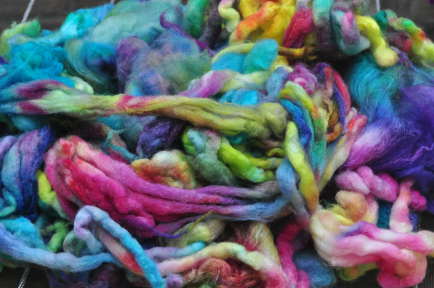
I did a few more low immersion dyeing experiments last week. I had some fibre reactive dyes which needed using up.  Dyeing protein fibres with fibre reactive dyes is a similar process as using acid dyes.  Slightly different percentages, and a bit of synthropol added to the mix.  Heat is needed to set the dyes on wool, rather than time as on cellulose fibres.   This multi-coloured batch is a bit larger than the others as well, as I had about 130 g of the same blend fibre left in 2 bags, which I combined. My main worry with this batch was the fibres were a bit crowded.  I had to be quite careful that the bottom layers of fibre were dyed adequately.   It turned out quite spectacularly for a random blend of colours.

I had enough old dyes for two experiments.  Then I took the time to mix up new dyes.   This is fuchsia and  turquoise.  It is 100 g, which seems to be a good amount in my pan for this type of dyeing.   It turned out quite lovely, with the bright but not glaring colours and gentle colour transitions.  I lay the roving in the pan in a zig zag fashion, across the narrow end of the pan and back again.  I poured the dyes on in layers or in rows, from lighter to darkest, in the pan, keeping the same back and forth motion with the dye application as I'd used with laying the fibre in the pan.  This one was fun to see take up and set.


 Oh, the brightness of this one.  This is for spinning on a dull, grey, winter day.   I used yellow and fuchsia, in random splotches.  It made my day when I pulled that out of the dye pot. 

The one below used fuchsia, blue and black.  It was also with the end lot of the old dyes.   I left a bit of white fibre on purpose for mellowing down the colours.   This is a blend which I'm betting looks awesome when spun.  I love to see how some of the fibre colours appear to change once they are spun.  The blending of the colours makes a lot of difference sometimes.

Today's experiment is solar dyeing.   Really, our weather in July was the prime time for solar dyeing, but I'm doing this at Westfield on Sunday, so thought a few experiments to show would be nice.  These two are using fibre reactive dyes.   I've also got food colours and the Kool-Aid powder that we found when my daughter and I were out fabric hunting in July.   I've lots of bits of fibre from random fleeces which I'm using.   
 I'll do up a post with a better explanation of the solar dyes, once I've got a few more samples.  The pink jar is leftovers from the last dye session and the multi coloured jar is just splashes of 3 different colours, applied to different areas of the fibre in the jar,  with a syringe